

Science · MeshMHD
MeshMHD, a physical model of the Sun’s magnetic field.
MeshMHD rebuilds in 3D the magnetic structures behind solar eruptions. The work was led by Tahar Amari at CPHT (CNRS / École polytechnique). SKEION’s technology comes from it.

The model
How MeshMHD works.
It solves the equations of the solar plasma
The Sun’s outer atmosphere, the corona, is a plasma: a hot, electrically charged gas threaded by magnetic fields. Plasma and field drag each other along. MeshMHD solves the equations of this coupling in 3D, called magnetohydrodynamics (MHD). They describe how mass, momentum, energy and the magnetic field evolve.
Fine detail where the physics needs it
The model divides space into cells, an adaptive mesh. Cells are small where magnetic structures are thin, such as a flux rope, and larger elsewhere.
Published results
Two results on the cover of Nature.
-
2014
The flux rope behind a major eruption
The model started from four days of measurements of the Sun’s magnetic field, before a major eruption (December 2006). It rebuilt the twisted structure (a flux rope) behind it.
Class X3.4 flare · Amari, Canou & Aly, Nature 514, 465 (2014) · doi:10.1038/nature13815
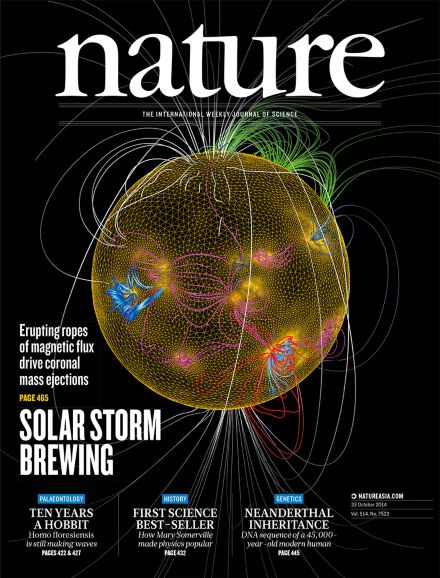
-
2018
Why an eruption stays confined
It showed why a major eruption in October 2014 ejected nothing: a “magnetic cage” held the twisted structure in.
Amari, Canou, Aly, Delyon & Alauzet, Nature 554, 211 (2018) · doi:10.1038/nature24671
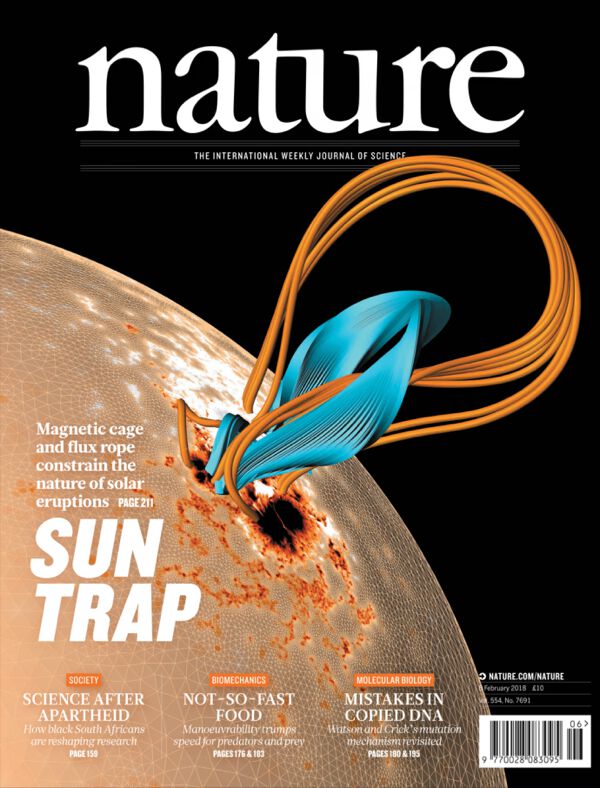


Our ambition: to tell, before an eruption starts, whether it will eject matter or stay confined. This bears directly on false alarms. Our goal is not to promise, but to prove.
The researcher
Tahar Amari led the MeshMHD research.

Tahar Amari is a Director of Research at the Centre de physique théorique (CPHT). He has worked on solar physics for 30 years. He is SKEION’s scientific co-founder.
His other papers: the heating of the solar atmosphere (Nature, 2015) and twisted flux ropes in the quiet Sun (2025).
Glossary
Key terms.
- Magnetohydrodynamics (MHD)
- The physics of electrically conducting fluids, such as the solar plasma, and of the magnetic fields they carry along.
- Magnetic flux rope
- A bundle of magnetic field lines wound around one another, which stores the energy of an eruption.
- Magnetic cage
- The magnetic arches that lie over a flux rope and hold it down. Its strength decides whether an eruption ejects matter or stays confined (Amari et al., 2018).
- Coronal mass ejection (CME)
- A cloud of plasma and magnetic field expelled from the solar corona, at about 250 to nearly 3,000 km/s.
Further reading: NOAA on coronal mass ejections · NASA on the magnetic cage (2018).
Questions
Common questions.
What is MeshMHD used for?
In research, it rebuilds the magnetic configuration of the solar corona before and during eruptions. It starts from observations of the Sun’s magnetic field. On this basis, SKEION is developing Event Replay: the replay of a past solar storm of your choice, adapted with you to your grid or your satellites.
Physical or statistical model: what is the difference?
A statistical model learns correlations from past events. A physical model computes how the plasma and the magnetic field evolve, from the laws of physics. Its results read as structures, such as a flux rope and its cage.
Where does SKEION’s technology come from?
From CNRS research: MeshMHD and the results published in Nature. SKEION is supported by CNRS Innovation (RISE programme). Intellectual property in the work originating from CNRS is set out in the legal notice.
Where can I read the papers?
Through their DOI: each reference links to the article. The 2014 and 2018 articles made the cover of Nature (issues of 23 October 2014 and 8 February 2018).
References
The papers.
- Amari, T., Canou, A. & Aly, J.-J. (2014). Characterizing and predicting the magnetic environment leading to solar eruptions. Nature 514, 465–469. doi:10.1038/nature13815 · cover
- Amari, T., Luciani, J.-F. & Aly, J.-J. (2015). Small-scale dynamo magnetism as the driver for heating the solar atmosphere. Nature 522, 188–191. doi:10.1038/nature14478
- Amari, T., Canou, A., Aly, J.-J., Delyon, F. & Alauzet, F. (2018). Magnetic cage and rope as the key for solar eruptions. Nature 554, 211–215. doi:10.1038/nature24671 · cover
- Amari, T., Canou, A., Velli, M. et al. (2025). The Ubiquity of Twisted Flux Ropes in the Quiet Sun. The Astrophysical Journal Letters 984, L37. doi:10.3847/2041-8213/adb74f
A pilot project with SKEION?
In a pilot project, we explore with you how our solutions can meet your specific needs and solve your problems. From your case, we adapt and improve them so they fit the way your teams work.